
What Does “Gender Extremism” Mean and Why LGBTQ Professionals Should Pay Attention
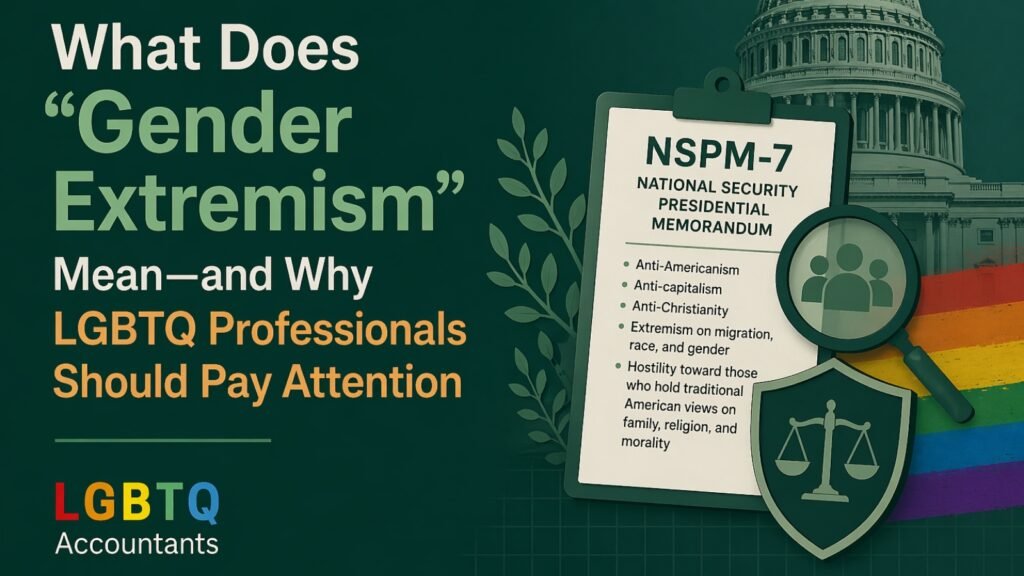
Over the past week, you may have seen headlines or social media posts about gender extremism claiming that LGBTQ+ people are being classified as “terrorists” by the federal government.
That’s a serious claim—and one worth slowing down and examining carefully.
Most of this language comes from reporting on the proposed budget request, rather than a single publicly searchable document.
Because like many things in today’s environment, the truth sits somewhere between what’s written and what people fear it could become.
🔍 What We Know
A recently proposed federal budget includes increased funding for FBI counterterrorism efforts, along with language identifying potential threats tied to certain ideologies.
Among those listed are beliefs or motivations associated with:
- “Anti-Americanism”
- “Anti-capitalism”
- “Anti-Christianity”
- “Extremism on migration, race, and gender”
- “Hostility toward those who hold traditional American views on family, religion, and morality”
This language is tied to a broader directive known as National Security Presidential Memorandum-7 (NSPM-7).
NSPM-7, issued in September 2025, directs federal agencies to take a coordinated approach to countering domestic terrorism and organized political violence. It expands the focus beyond individual actors to include:
- Networks and organizations
- Funding sources
- Online ecosystems and influence structures
In other words, it applies a post-9/11-style counterterrorism framework to domestic activity, with coordination across multiple agencies.
👉 When viewed together, these categories span many of the major ideological fault lines in current public discourse—particularly around culture, identity, and politics.
The proposal also includes expanded coordination and increased focus on monitoring potential threats, including online activity.
❗ What We Don’t Know
Here’s the critical part:
There is no clear statement in the policy itself that:
- LGBTQ+ people are classified as terrorists
- Simply being LGBTQ+ is considered a threat
Those claims are interpretations, not direct quotes from the policy language.
It’s also important to note that most of the publicly discussed wording comes from reporting on the budget request and related materials, rather than a single, easily searchable, line-by-line policy document.
And that distinction matters.
⚠️ Why People Are Paying Attention Anyway
Even without explicit language, there are valid concerns being raised—particularly around the phrase:
“Extremism on… gender”
That term is not clearly defined.
And when broad, undefined language is placed inside a national security framework, it creates room for interpretation.
Civil liberties advocates have warned that this kind of framing can:
- Blur the line between identity and ideology
- Conflate advocacy with extremism
- Expand surveillance or enforcement powers in ways that may not be obvious at first
This doesn’t mean those outcomes are guaranteed.
But it does mean the language deserves attention.
🧭 What This Does—and Doesn’t Do (Right Now)
To stay grounded, it helps to separate impact from possibility.
What this does:
- Signals that “extremism on gender” is being treated as a potential domestic terrorism motivator
- Funds expanded investigative and coordination efforts across federal agencies
- Emphasizes identifying networks, funding, and support structures
What this does not (at least today):
- Criminalize LGBTQ+ identity or advocacy
- Create a new legal category that labels LGBTQ+ people as terrorists
- Automatically trigger enforcement against LGBTQ+ individuals or organizations
These actions shape investigative priorities, not criminal statutes. That distinction is key to understanding both the current reality and the potential risk.
🕰️ Why This Feels Familiar
For many in the LGBTQ+ community, this isn’t just theoretical.
It echoes history.
In 2003, the U.S. Supreme Court decided Lawrence v. Texas, striking down laws that criminalized same-sex relationships.
Those laws weren’t ancient history—they were actively used to justify surveillance, arrest, and discrimination.
And in Texas, the underlying statute still exists on the books today. It’s unenforceable under current precedent—but not erased.
That matters because it’s a reminder of something important:
Legal frameworks can change faster than we expect.
And language—especially in policy—often comes before enforcement.
🧠 The Bigger Picture
For many outside the LGBTQ+ community, this may read as abstract political language.
For those inside it, the concern is more personal.
It’s not about assuming the worst.
It’s about recognizing patterns:
- How groups are described
- How language evolves
- How policy frameworks expand over time
What starts as vague classification can, in some cases, evolve into something more concrete.
Again, that’s not a prediction—it’s a pattern history has shown before.
💼 Why This Matters for LGBTQ Professionals
If you’re involved in:
- Advocacy
- Education
- Community building
- Professional networking (yes—even something like LGBTQ.accountants)
…it’s reasonable to ask:
Where is the line between “community” and “ideology” in a framework like this?
Right now, there is no clear answer.
And that uncertainty is exactly why people are paying attention.
🧭 Don’t Panic—But Don’t Ignore It Either
This isn’t a moment for fear.
It’s a moment for clarity.
Understanding what policies actually say—and how they could be interpreted—is how communities stay informed and prepared without becoming reactive.
🎤 Want to Go Deeper?
If you want a deeper legal analysis beyond this overview, there’s an upcoming session that may be helpful. Attorney Angela Giampolo is hosting a session that will unpack this issue in detail, including:
- What the federal language actually says
- Whether LGBTQ+ people are directly named or indirectly included
- How “extremism” language has been used historically
- What this could mean in practice
If you want a deeper legal perspective, this is a great next step.
Date: Tuesday, April 21, 2026
Time: 9am Pacific / 12 pm Eastern
🧩 Final Thought
The conversation right now isn’t really about whether LGBTQ+ people are being labeled as terrorists.
It’s about something more subtle—and arguably more important:
How language shapes possibility.
And why paying attention early matters.
More reading on this topic:
These pieces reflect the interpretations and concerns of the authors and advocates in the LGBTQ spaces.
Trump’s new FBI budget targets LGBTQ+ “terrorists” to combat “gender extremism” from LGBTQ Nation
Trump’s new budget turns the FBI into the gender police from The Advocate
